

Following promotion from the National League, York are looking to push on and challenge towards the top end of League Two this season. It’s often said that the gap between the two leagues is smaller than ever, but how true is this?
Let’s take a look at how the eight clubs most recently promoted from the National League have fared since returning to the EFL, and see what lessons might be taken on board for City.
1. Promoted sides do well!
The first point is a simple one, but worth highlighting: the teams who have come up from the National League over the last four seasons have progressed very well, not only in their first season back but in subsequent campaigns. Half of these clubs will be plying their trade at an even higher level than League Two in 2026/27: while Wrexham’s rise to the Championship may be a special case, Stockport have followed up automatic promotion from League Two with consecutive 3rd place finishes in League One, and they will be joined in the third tier next season by Bromley and Notts County. The other four remain in League Two but have not stagnated either, with all of them finishing either in a playoff position or just outside the top 7 last season.
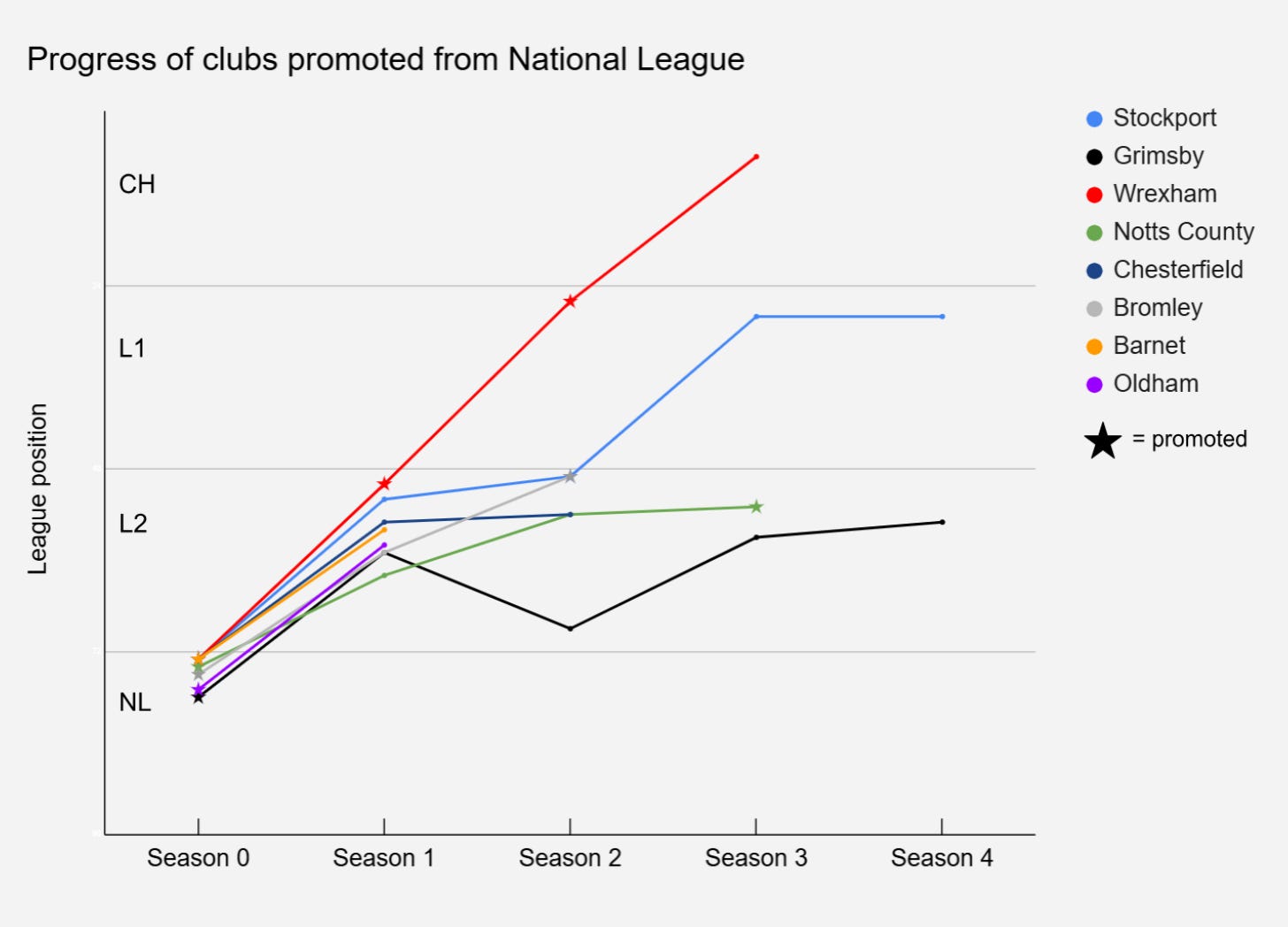
For these sides who have escaped non-league recently, seasons of struggle have been rare. In fact, looking at their 20 collective league placings since returning to the EFL, there are 18 top-half finishes and only 2 bottom-half finishes. The outliers are Grimsby's difficult second season back in League Two in which they finished 21st, and Notts County’s first season back (under Stuart Maynard for the second half of the campaign) which produced a mid-table finish of 14th. Both teams have kicked on since then, however, and both finished in the playoffs last season, with Notts County gaining promotion. The overall trend points towards City being much more likely to challenge towards the top end of League Two than face a season of struggle like the one experienced the last time they returned to the league in 2012/13.
2. The winner takes it all
Looking at the league finishes of teams promoted from the National League, there seems to be an advantage to gaining promotion as league winners: in each of the last four seasons, the side who went up as champions have finished higher in League Two the following season than the side who were promoted via the playoffs. Three of the four most recent National League champions (Stockport, Wrexham and Chesterfield) have finished in at least the playoffs in their first season back, with Barnet coming close to this feat but ultimately finishing 8th last season. None of the four sides promoted via the National League playoffs, on the other hand, have recorded a top seven finish in their first season back.
There are a few potential reasons for this: an obvious one is that winning the league suggests they were a stronger side than the playoff winners anyway, while the extra time to plan for the following season may give a slight advantage in recruitment (as well as a couple of weeks’ extra rest for the squad).
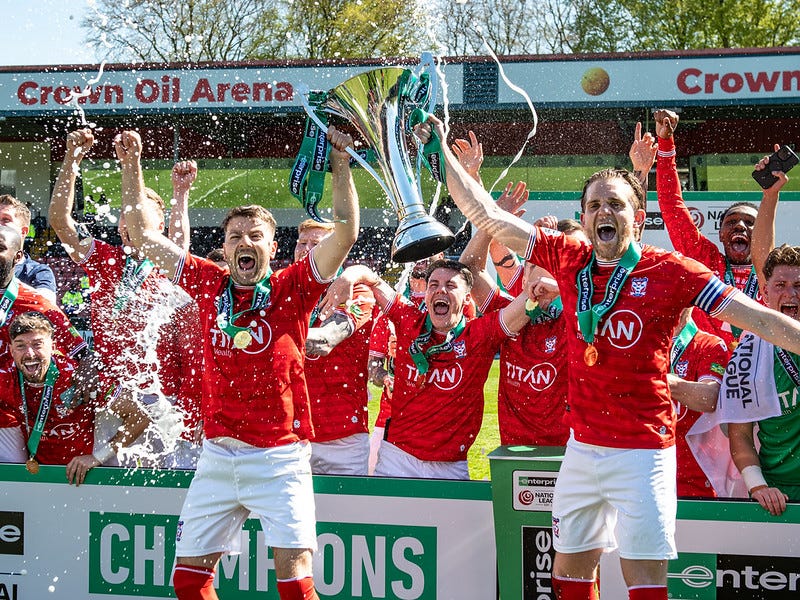
York might, therefore, feel good about their chances of finishing above Rochdale again. But don’t write off Dale just yet: league finishes from subsequent seasons show that playoff winners can catch up, as evidenced by Bromley finishing below Chesterfield in 2024/25 but then leapfrogging them last season to be promoted as League Two champions.
3. Possession isn’t nine tenths of the law
City’s success last season was built on dominating possession: their average of 62.8% possession was higher than any other National League clubs, and a remarkably high average in general (among the 92 Premier League and EFL clubs, only Manchester City and Cardiff had averages over 60% last season). This reflects a trend where the top spots in the National League are generally taken by teams with a possession-heavy style - Barnet and Chesterfield also averaged over 60% in their title-winning National League campaigns.
A quick look at the possession figures from League Two last season, however, tells quite a different story. None of the five teams ranked highest for average possession finished in the automatic promotion spaces - while four of them finished between 5th and 8th, Crawley were a real outlier as they only just escaped relegation despite having the second highest possession in the league. Champions Bromley, on the other hand, had the third lowest possession average in the league, while MK Dons and Cambridge also won automatic promotion with fairly middling possession stats.
Barnet and Oldham, who both came up from the National League in 2024/25, present an interesting contrast: Barnet typically dominate possession while Oldham are happier to let their opponents have the ball. While Barnet did finish above Oldham again in 2025/26, the gap between the two sides was cut from 29 points in the National League the previous season to just 8 points in League Two.
The lesson for York is that a possession-based approach may be a less dependable route to success in League Two than it is in the National League. There may be a greater need for a plan B which involves less reliance on dominating the midfield battle and more on effectiveness in both boxes. We did see hints of this at times last season - the 3-0 win at Scunthorpe on a dreadful Glanford Park pitch was achieved with just 44% possession as we switched to a more direct approach - so there are reasons to be optimistic that Stuart Maynard can change tactics where needed, and that the squad is versatile enough to adapt to different styles of play.
4. Set pieces can be vital
How did Bromley manage to win League Two last season without having much of the ball? A big part of the answer is set pieces. Goals from set pieces have been increasing across English football in recent years, and nowhere is this more pronounced than in League Two, with 31.8% of all goals scored in the league coming from set pieces last season.
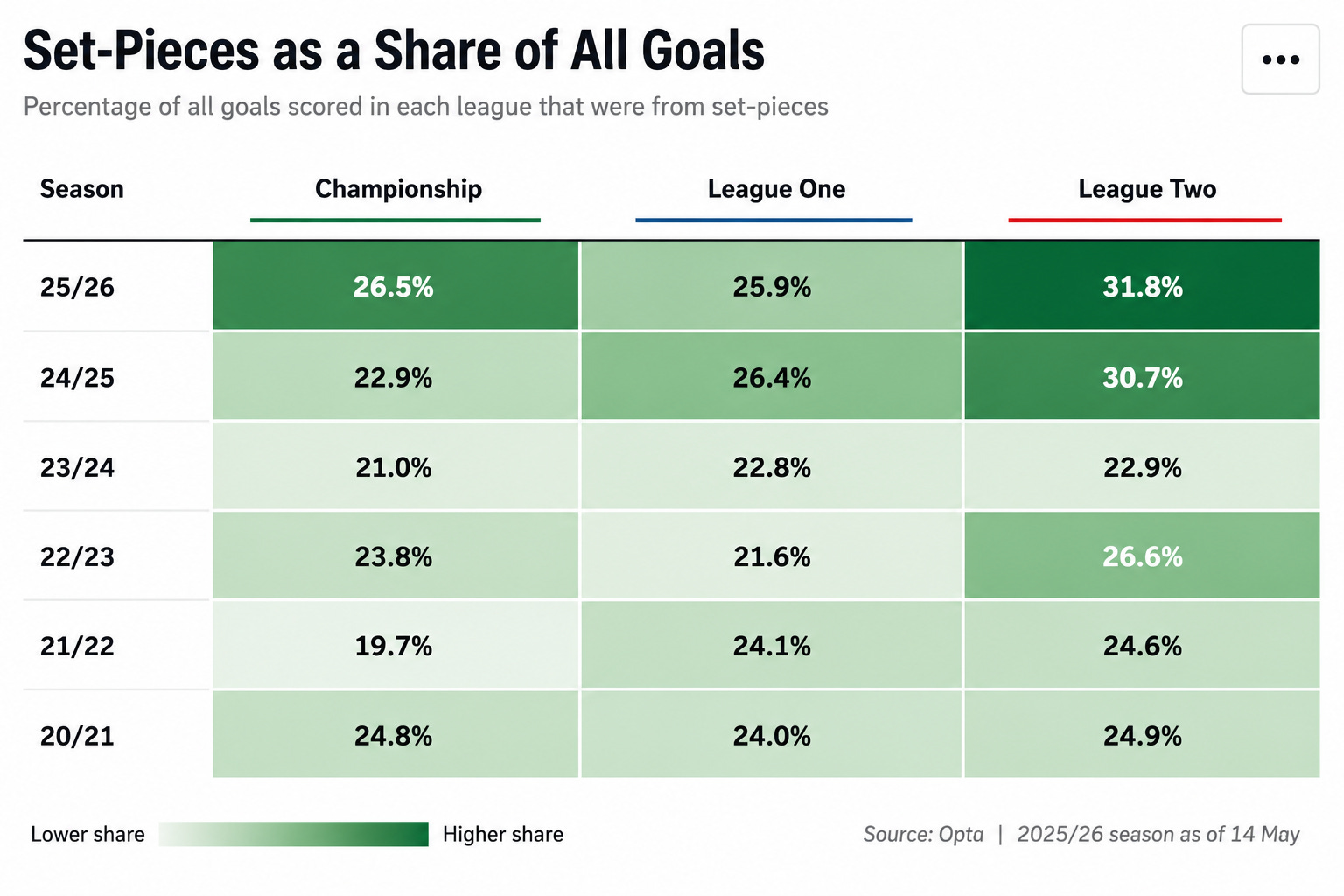
Not only is the proportion of set piece goals increasing, but there’s also a growing correlation between a team’s performance in the league and how many set piece goals they score. This is reflected in the fact that the teams with the highest number of set piece goals in their league last season were title winners in the Premier League (Arsenal), Championship (Coventry), League One (Lincoln) and League Two (Bromley). The example of Bromley is most relevant here - 44% of their goals came from set pieces, as they found ways to hurt opponents even while having relatively little possession. This relied heavily on the accurate deliveries of Mitch Pinnock, who created by far the most chances in the league at 137 over the season, along with physically imposing players capable of winning aerial battles to get on the end of these deliveries, like 6ft 6in centre-back Omar Sowumni who scored 7 goals from set pieces.
This trend could be a concern for York, but also an opportunity. City’s defending at set pieces occasionally let them down last season, for instance in the 3-2 defeat at Boreham Wood where all three goals conceded came from not dealing effectively with a set piece delivery. Matt Uggla mentioned this as an area of focus in his post-season interview with York Hospital Ball, so we can expect that one aim of this summer’s recruitment may be to reduce the number of set piece goals conceded. But the potential for York to make effective use of set pieces in an attacking sense should not be overlooked: there are players in the squad capable of delivering accurate set pieces (Alex Hunt’s free-kicks and corners, Ben Brookes’ long throw), and they have been joined by the likes of Arthur Read and Frankie Maguire who both have a track record of racking up assists from set pieces.
5. These things take time
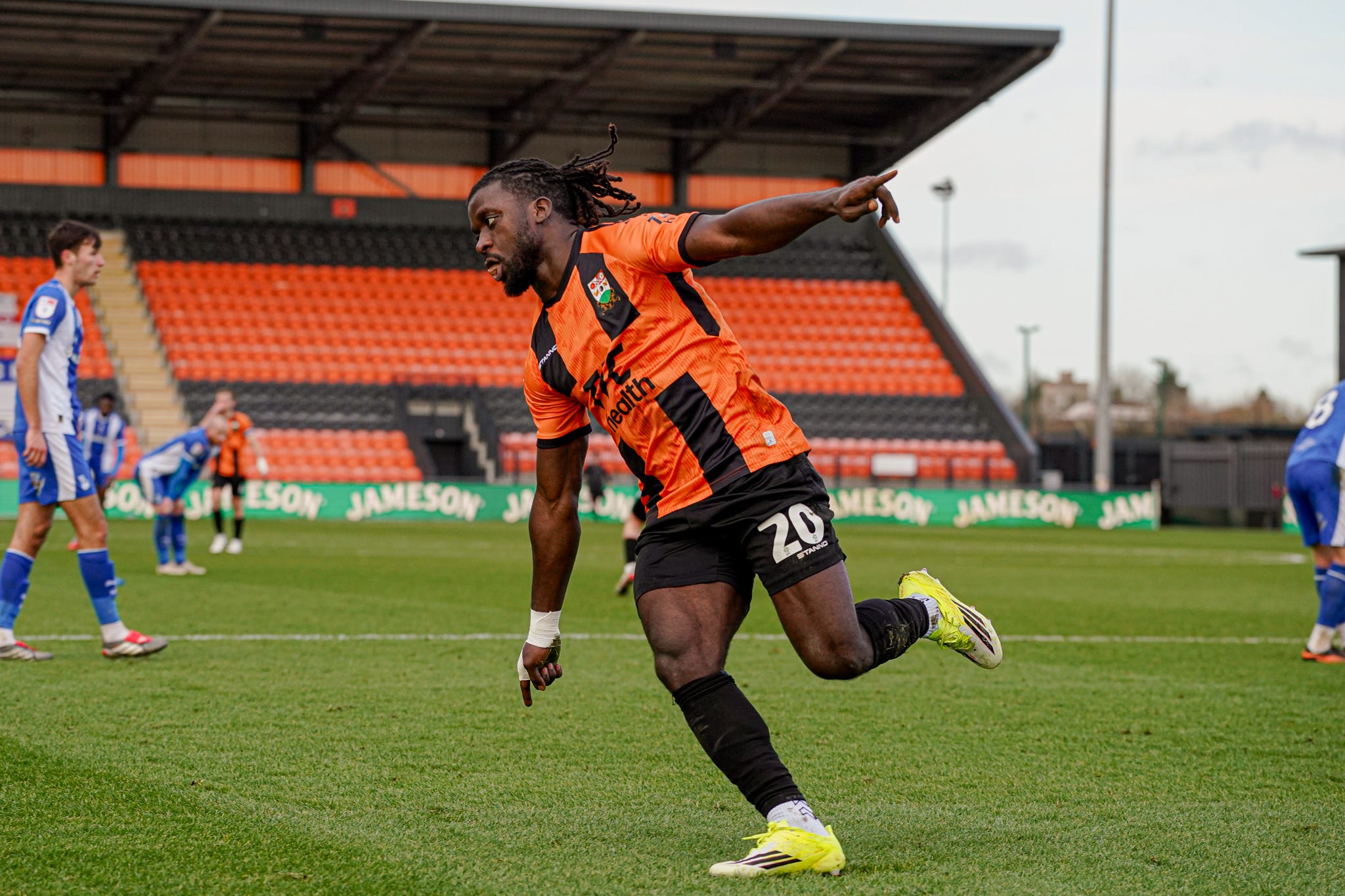
While teams promoted from the National League have almost all thrived in League Two recently, they’ve sometimes had to recover from a slow start. Last season, Barnet lost their first 3 games and only managed 7 wins in the league before Christmas as they experimented with different formations and personnel. After January, though, a reliable goalscorer arrived in the form of Kabongo Tshimanga and their results improved. By the end of the season, they were hitting promotion form, with 7 wins from their last 8 games. Oldham also got off to a sluggish start in 2025/26, failing to win any of their first 6 games. They spent most of the season in the bottom half of the league, but a hot streak of 8 wins from 9 games in February and March raised hopes of a late playoff push, only for them to fall away again in April and end up in 10th.
There are plenty of other examples of teams being slow out of the traps in their first season back in the league, but going on to improve. Stockport were in the bottom half of the league as late as January in 2022/23 but went on to finish 4th; Wrexham only won 6 of their first 14 games the season after but ultimately gained automatic promotion; and Bromley were only 3 points clear of the drop zone in early December of their first league season but finished well clear of danger in 11th. It’s probably unsurprising that there would be an initial period of adjusting to a new league with a consistently stronger level of opponent and perhaps a greater physical challenge.
If York don’t get off to a flying start, then, it would be wise not to panic. This is particularly true considering that the fixtures for August and September look difficult. And while it might be optimistic to hope for a repeat of last season's points tally, it's worth remembering that a team sitting 7th in the league at the start of November can end up as champions with 108 points.