

Having looked at the goalkeeping, centre-back and wing-back positions, our focus now turns to assessing York’s options in midfield and up front. There are a wealth of options in several of these positions, with last season’s title-winning squad mostly kept intact and joined by several new additions. Who might get the nod in Stuart Maynard’s starting line-up?
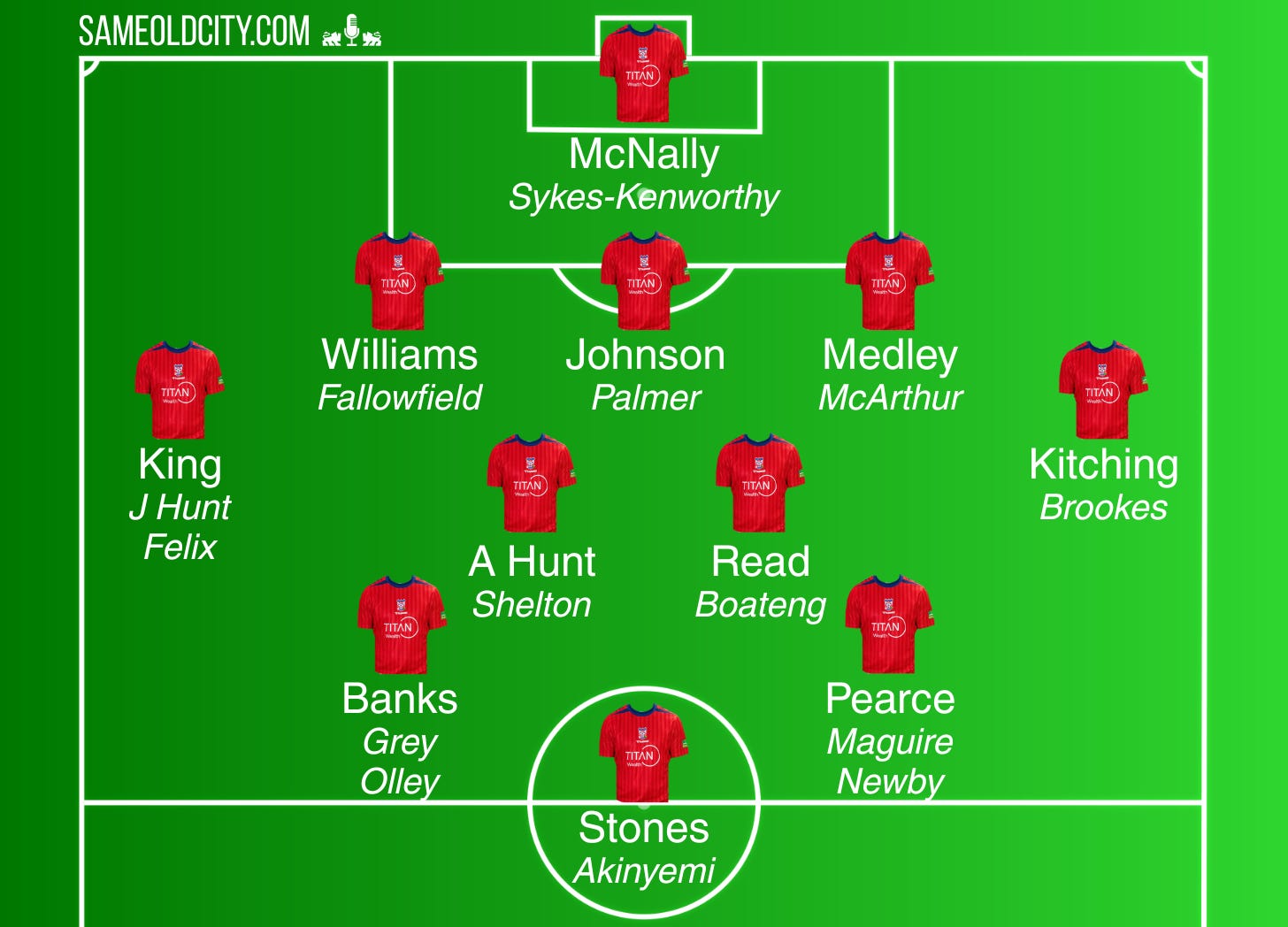
Deep-lying midfield (right)
Last season, Alex Hunt made this position his own: his ability to initiate passing moves from deep-lying positions was crucial to York’s success in playing out from the back. He also saw plenty of involvement in the final third, chipping in with an impressive 9 goals and often being the go-to taker for free-kicks and corners. On a technical level, Hunt should have no trouble stepping up into League Two, but there are reasons why his starting place might not be quite so assured this season. Firstly, he didn’t quite make the grade at this level in previous spells with Oldham and Grimsby (although he has undoubtedly developed as a player since then so this might not be a huge concern). Secondly, his lack of physicality has occasionally seen him become targeted by opponents who feel he could be bullied out of a game, and this could be even more prevalent in the highly physical environment of League Two.
The other reason why Hunt may not be a guaranteed starter is that the Minstermen have brought in impressive-looking reinforcements to compete for the midfield roles. The most direct competition for Hunt’s place may come from Mark Shelton. A different type of player to Hunt, Shelton is a box-to-box midfielder who may not be as technically accomplished on the ball but offers plenty of running and has a knack for timing runs into the box perfectly to get on the scoresheet. It may be that Hunt is favoured for certain games where retaining possession is key, while Shelton is brought in for games expected to be more physical, end-to-end battles.
The other two players most likely to play a deeper midfield role, Arthur Read and Hiram Boateng, are both left-footed so would probably be fielded on the left unless paired together. Another option would be for Ollie Banks to drop back from his more usual position in attacking midfield: this happened on occasion last season, but given our improved options this season I would not expect to see Banks used here regularly.
Deep-lying midfield (left)
This was the space occupied by Hiram Boateng for most of last season: after Maynard experimented with a midfield pairing of Hunt and Batty for a while, Boateng returned and made himself undroppable, starting every game after Boxing Day until the end of the season. His physical presence, along with his ability to win duels and second balls, provided an ideal counterpoint to Alex Hunt and was vital in helping York scrap through awkward games towards the season’s end. As a left-footer, he also offers balance, and was happy to join in attacks when needed, swinging in crosses from the left. Boateng won’t be starting the season here, though, having suffered an injury expected to rule him out for 8-12 weeks, as well as facing a possible ban following his scuffle with a Rochdale fan in April.
Boateng’s absence at the start of the season simplifies the equation here, as the starting role is likely to be taken by another left-footed midfielder in the form of Arthur Read. Arriving off the back of three successful seasons at Colchester, and having been named in the 2025/26 League Two team of the season, Read will surely be expected to be one of the first names on Stuart Maynard’s team sheet. Read is a highly technical player with a good passing range and an eye for goal, so if paired with Alex Hunt this could suggest City are doubling down on the possession-heavy style that served them well in the National League. Alternatively, it may be that the energy of Mark Shelton is seen as providing a better balance alongside Read at the base of midfield.
Further cover here, particularly while Boateng is missing, could perhaps be provided by Joe Felix. With Maynard seemingly reluctant to use Felix at right wing-back, a reprise of his occasional midfield role under Adam Hinshelwood might be a route back into the team. This possibility has been given greater weight by Felix featuring in midfield during pre-season. A starting role in midfield seems unlikely, but off the bench his dynamism and intensity could be useful when the starting midfielders begin to tire.
Attacking midfield (right)
The two attacking midfield positions are an area where City are spoilt for choice. Ollie Banks was a crucial attacking outlet last season, particularly over the second half of the season, with his ability to whip in accurate crosses from the right proving a fruitful source of chances. Based on this level of performance, and his recent experience of League Two with Chesterfield, he could expect to be first choice for this role. The only caveat is that Maynard acknowledged it was a challenge for Banks to start two games in a week last season. In a higher league, and with Banks set to turn 34 in September, it would not be a surprise to see regular rotation for the right attacking midfield spot.
This was also the role most commonly occupied by Greg Olley for his appearances in the team last season. His campaign was somewhat stop-start due to injury, and he didn’t have the consistent impact of Banks, but he did show some moments of quality that underlined why he had developed such a good reputation at Gateshead. Having never made an appearance in the EFL before, Olley will undoubtedly be keen to take the opportunity to prove himself in League Two. Competition will be fierce but, with a full pre-season programme behind him this season, Olley may well be given game time by Stuart Maynard.
Joe Grey is another contender for the right attacking midfield spot, although he has played a variety of other positions including right wing-back. His strengths are different to Banks or Olley: while they may be more creative, Grey offers pace, directness and dribbling. He could therefore be particularly useful off the bench to stretch tired defences, or in games where we expect opponents to leave space in behind.
Frankie Maguire is another player who would be well-suited to this role, but I’ve included him in the next section on left-sided attacking midfield options. Alex Hunt was also used in this more advanced role occasionally last season, but seems a more natural fit in his usual deeper-lying midfield position.
Attacking midfield (left)
After playing the 2024/25 season as a centre-forward under Adam Hinshelwood and retaining this role for Stuart Maynard’s first two months in charge, Ollie Pearce had to adjust to a new more withdrawn role on the left to accommodate Josh Stones up front. Luckily, his adaptability and footballing intelligence meant that he took to this role change quickly, finding a way to take on the new responsibilities of attacking midfield while still retaining his scoring threat and finishing the season with an incredible 35 goals. In fact, his new position may have made it even more difficult for defences to deal with his runs into space. With Stones secure as the starting no.9, it’s hard to look beyond Pearce as the first choice for this position.
Frankie Maguire joined the club this summer after two successful seasons at Boston United, and will go straight into the mix as a contender for the two attacking midfield places. Naturally right-footed, he would be comfortable on the right but could equally be used on the left cutting inside onto his stronger foot. It will be difficult to displace Pearce from the side, but the rigours of a first campaign in league football for Pearce may mean that his minutes are managed more carefully. Maguire is more of a natural crosser, so would be a creative outlet here even if not carrying the same goal threat as Pearce.
A further option on the left is Alex Newby: while he played more often at left wing-back last season and was productive, the defensive side of his game was less convincing and Ben Brookes was preferred towards the end of the campaign. If he has a role this season, it would probably be in this left-sided attacking midfield role, where he could get opportunities to draw on his main strengths of beating defenders one-on-one and getting accurate shots away from outside the area.
Hiram Boateng was used a handful of times in attacking midfield last season, but will be much more likely to play further back. Dipo Akinyemi did feature on the left of a front three regularly for City under Adam Hinshelwood, but given that being played out of position was expressed as a key reason for him leaving the club, it seems unlikely that he would appear anywhere other than his preferred centre-forward role this season.
Centre forward
With a new five-year contract signed, Josh Stones is clearly established as the club’s first-choice no.9. Having had to play second fiddle to Ollie Pearce for months, Stones seized his opportunity and became one of the standout performers for City last season. His energy and physicality caused all kinds of issues for National League defenders, and there’s no reason this can’t continue in League Two: his performance at Barnsley in the FA Cup showed how he can thrive against higher-level defences. Despite only breaking into the starting line-up in November, he reached a very respectable tally of 18 goals, as well as chipping in with a fair few assists. Plus, at just 22 years of age, there is plenty of scope for his all-round game to improve yet further.
Dipo Akinyemi returned to the club this summer after a year at Derry City, and looks set to fill the spot that York lacked for much of last season after Ollie Pearce’s role changed: a second centre-forward option to compete with Josh Stones. City fans know the qualities that Akinyemi can bring if he stays fit: explosiveness, physicality and composure in front of goal. While not exactly the same type of attacker as Stones, he is certainly more similar in profile than Pearce, so should allow City to switch strikers without needing to adapt their tactical approach too much. Given Stones’ performances last season and how highly regarded he is at York, it seems likely that Akinyemi would be the backup option, but rest and rotation should see him get a decent amount of game time. The only question mark is over whether he can stay injury-free, after a series of niggles over the last few seasons limited his availability.
Of course, Ollie Pearce always remains an option in the centre-forward role. Having adapted so well to a more withdrawn role last season, though, I would expect him to remain there in support of Stones (or Akinyemi). While he was prolific when playing at no.9 in the National League, his relative lack of size and physicality may be more exposed if playing through the middle in League Two and would reduce City’s ability to offer a threat from long balls.
Joe Grey has played at centre-forward before, and was occasionally used here in the closing stages of games for York last season, so offers an option in specific circumstances where more pace is called for. Craig Hewitt also saw some game time as a makeshift centre-forward off the bench last season, but had minimal involvement as the season progressed and will probably struggle to make City’s 22-man squad for the season.
We’ll revisit the squad depth around the time of the transfer window closing, to assess the options in York’s finalised squad.